Friday, 6 January 2017

East and West Lulworth - 4th December 2016

Since moving to the south-west I've acquired several books about the history and natural history of the area and, having an inquisitive mind and, initially at least, time on my hands, I set about learning all I could about the new places I'd yet to discover.

One such place was Lulworth Castle. We'd visited Lulworth Cove in the height of the summer last year and, having read so much about it, I have to confess I was disappointed. Any potential views were marred by a muddy field of uniformly grey cars, ice-cream stalls and throngs of people on every square inch of beach. Despite its legendary status as one of Dorset's beauty spots, Lulworth has quite an ugly beach; viewed from above it is attractive and admittedly sheltered as it is nearly entirely enclosed and protected from the elements on all but the most southerly side, which, along with its accessibility, make it an attractive spot for families. Of course these families have to pay the price for such facilities with expensive car parking. The beach itself is difficult to walk on and there is hardly any sand and seemingly nowhere to investigate rockpools, so it's not what I remember from my childhood days as being a typical family beach. Nevertheless, the surrounding area is beautiful and we decided to revisit on a winter's day and visit Lulworth Castle as well.

The attraction of Lulworth Castle was its Roman Catholic chapel. Apparently in the eighteenth century catholics could be persecuted for their faith so the Weld family, practising catholics, were advised they could  build a catholic chapel on their estate provided it did not resemble a religious building. Hence the building which stands there to this day under which, thankfully there is no longer any threat of persecution.

Our day began in glorious sunshine at St Andrew's Church at East Lulworth, where a wren had found its way into the building and seemed trapped. We kept the doors open whilst we were there and assume it got away; we certainly could not find it when we exited the church. 


St Andrew's Church, East Lulworth - SY8582

Our next stop was the Castle, just next door to the church. At first we were reluctant to spend any  daylight hours indoors on a day like today, but our reservations were soon swept away by the wonder of the Castle.
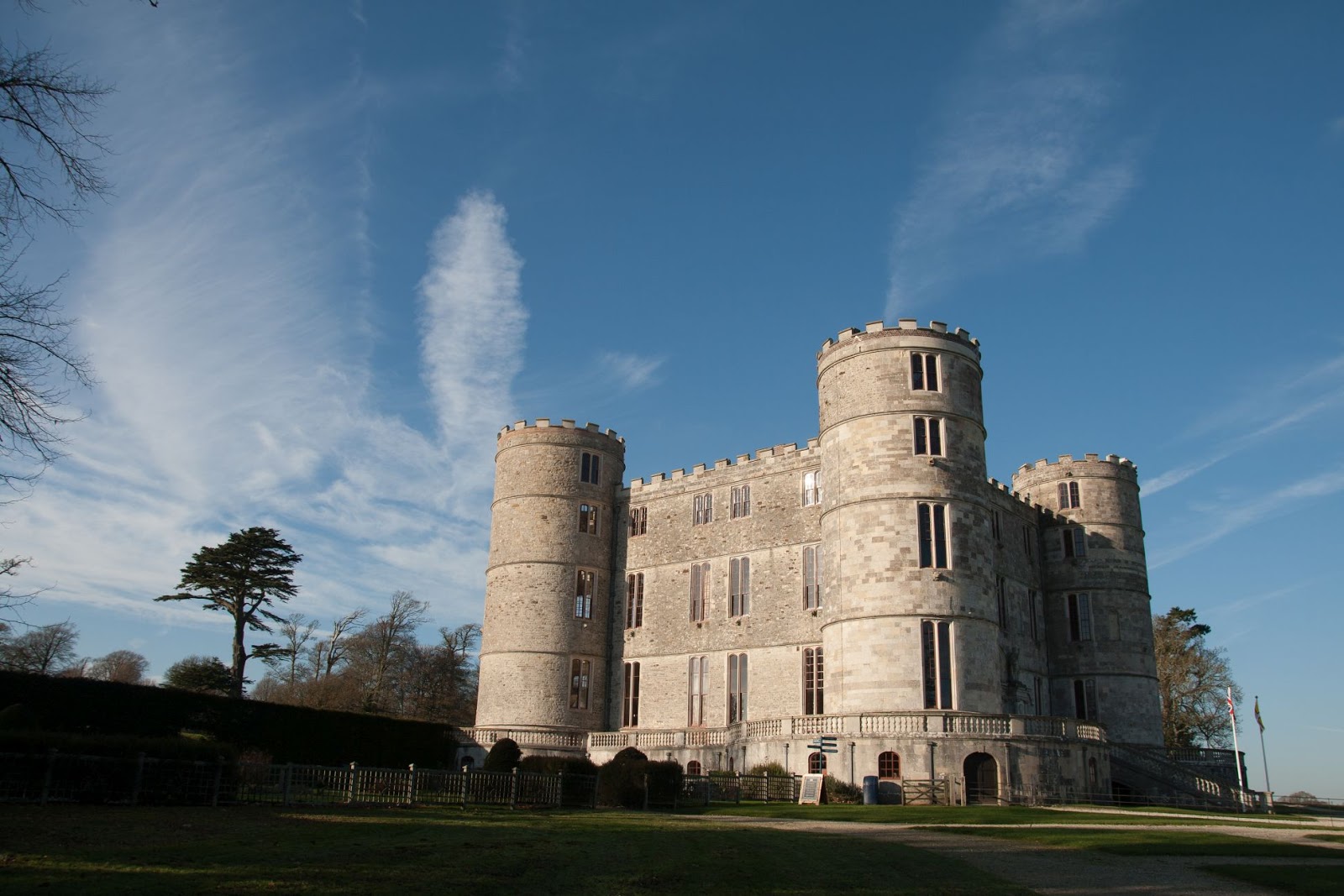
Lulworth Castle - SY8582

The Castle was completed  in 1609 and bought by Humphrey Weld in 1641.  Almost completely destroyed by a fire in 1929, the castle has been restored by English heritage and reopened in 1998. Still owned by the Weld family, it is now a major tourist attraction with mediaeval-themed events. The current Weld family reside in a separate building on the same estate. 

Christmas tree inside Lulworth Castle - SY8582

Suit of armour inside Lulworth Castle - SY8582

Door buckled by fire inside Lulworth Castle - SY8582

Inside Lulworth Castle - SY8582

King Charles' bedroom - inside Lulworth Castle - SY8582

St Mary's Roman Catholic church, East Lulworth - SY8582
No photography was allowed inside the ornate church, but it is well worth a visit to see the exquisitely painted roof and unusual yew chairs.

We spent longer than anticipated inside the Castle and chapel and then left for the coast, where we planned a short walk through the ranges, with the hope of finding Smugglers' Cave.

Having ascertained that the ranges were open, we started our walk just slightly inland, passing a radar station, which made a good feature for gridsquare SY8380.

Radar station within the Ranges - SY8380
We walked to Mupe Bay and had lunch overlooking this beautiful beach, equally as beautiful in my opinion as the much more popular Lulworth Cove.

Mupe Bay - SY8479

Mupe Bay - SY8479
We were disappointed to discover that, unless you wanted to risk life and limb, access to Smugglers' Cave was impossible. This coastline is dotted with a myriad of caves which were probably all used in days of yore for storing contraband goods. My mind returned to the wonders of 'Moonfleet', a book I have to confess I have only read this year and thoroughly recommend. There is a wonderful description of how young John Trenchard  is shot in the leg on the cliffs here by the excise men and struggles with a broken leg and is urged on by his companion Elzevir Block. They shelter in caves (perhaps Winspit). In lieu of Smugglers' Cave, I took a photo of a radar station for gridsquare SY8379.

Radar Station near Mupe Bay - SY8379
Again we were to be disappointed, this time by the inaccessibility of the Fossil Forest near Lulworth. The footpath has been closed due to the path being deemed unsafe. We viewed the fossilised trees from a distance.

Fossil forest, Lulworth - SY8379

Fossil forest, Lulworth - SY8379
 We looked down on, and then descended to Lulworth Cove, which we tramped across with difficulty, eager to reach Stair Hole before it got dark. On our last visit, we had not known of the existence of Stair Hole and others spoke highly of it, saying it had been quiet compared to the crowded nature of Lulworth where we had eaten our picnic, not knowing any better. So we were keen to see it for ourselves.


Lulworth Cove and Stair Hole - SY8279

We continued to Hambury Tout and then, tired after a full day, we turned back, retracing our steps to the car.

Hambury Tout trigpoint - SY8180

Number of new gridsquares: 6
Number of miles walked: 5.6
Number of churches visited: 2
Number of trigpoints: 1
Number of cuddly bats seen: 8
Number of cuddly bats missed:2

Abbotsbury to Littlebredy - 1st December 2016

This was part two of our previous week's walk, inspired by St Catherine. It has made it to number one in Becky's 2016 Solo Walks Chart, by dint of the sheer beauty and clarity of the day (yes, despite the pea-souper in the Valley of the Stones). Some days linger in the memory and you savour them over and over again . Today was such a day and one  I shall not forget in a hurry.

It started with the mist - for which I had to turn round at the petrol station on the A37 to return to the parking spot to take a photo.

View from A37 at 0800
At Abbotsbury I lingered once more in St Catherine's Chapel, seeking and finding poetic inspiration in its setting and legends.

St Catherine's Chapel, Abbotsbury - SY5784

St Catherine's Chapel, Abbotsbury - SY5784
Inside St Catherine's Chapel, Abbotsbury - SY5784
Seeing the bright sunshine outside the chapel, I eventually stole myself awaying form poetic musings and walked out into a scene of mist, rooks and cows.

Rooks and cows on St Catherine's Hill, Abbotsbury - SY5785
I made my way northwards across Abbotsbury Plains, casting lingering looks back to the sainted village of Abbotsbury.
Abbostbury - SY5785

Walking through Oxlip Coppice, I gradually entered thicker mist.

Oxlip coppice - SY5885
Abbotsbury Plains - SY5885
An unusual structure caught my eye, but I have not been able to find out what it is, unless it's just a tunnel - a rather attractive one at that!

Tunnel on Abbotsbury Plains - SY5885
I was surprised, but somehow comforted, to hear distant voices as I reached the end of a field. Surely I was in the middle of nowhere? Then I realised I was actually close to the road I'd driven down earlier in the day. In fact I was about to emerge onto that road to walk along it, starting at the point Paul and  I had identified as being the only sensible place to park if we wanted to quicky access the Valley of the Stones.

Bishop's Road - SY5886
I have to confess I fought disappointment as I wandered mindlessly along the road and very nearly turned back as the fog grew thicker and thicker. What was the point if I couldn't even photograph anything? Somehow I kept going, even braving a herd of (apparently friendly) Long-horned Cattle which are deliberately reared here to graze the important nature reserve. Again apparently there are some rare lichens here and I've always advocated lichen hunting in the winter when all else wildlife-wise fails. I didn't know about the lichen as I congratulated myself on walking courageously through what looked like a deadly herd of cattle (they didn't budge as it happened) and decided to carry on regardless.

I have to admit it was a little atmospheric here, though I wish I knew exactly what I was looking at. I'd assumed it was huge standing stones, but I guessed that even with this thick fog, large standing stones would loom mysteriously in front of me before I actually walked into one. If I'd known I intended walking here, I'd have done a bit of research. Another place to return to with Paul.

Valley of the Stones - SY6087
I've not counted those photos of the Valley of the Stones in my gridsquare count as I want to return in better weather. To count as a geograph, the photo needs to show features within that gridsquare quite clearly, and I don't think those photos do, even if they are atmospheric!

I took a boring photo of the minor road leading to Littlebredy for gridsquare SY5988 and caught a misty glimpse of Bridehead, also in that gridsquare.
Road to Littlebredy - SY5988

Bridehead - SY5988
I continued to the church, where I ate my lunch.

Church of St Mary, Littlebredy - SY5889
Still in mist and gone lunch time, I wondered if the mist had cleared at Abbotsbury. If not, I doubted it would ever clear that day. I was cheered by the presence of a sign inviting people to walk in the grounds of Bridehead and I soon heard the rushing of a waterfall and walked in that direction.

Waterfall in Bridehead grounds - SY5888
This gave me an opportunity to acquire a gridsquare I wouldn't otherwise have walked in today. I couldn't rejoin the footpath from here, however, so retraced my steps through the sleepy village to a footpath sign leading southwards.

Here I entered fairyland - a magical place full of dewy webs and silvery threads created by the mist and peeping sunshine. You see, if I'd followed my instincts and turned back I would have missed this wonderland. I was in awe, gasping and clicking at every shrouded umbellifer.

Dewy grass near the Valley of the Stones - SY5988

Dewy grass near the Valley of the Stones - SY5988

Fairy chandelier in the Valley of the Stones - SY5988

Fairy chandelier in the Valley of the Stones - SY5988

Looming out of the mist - near Littlebredy - SY5988
Still in wonder, I emerged from the mist into glorious sunshine at Toppart's Dairy, where a sunny sign invited me back into the Valley of the Stones. No, I wanted to leave it shrouded in mystery to return to with new anticipation.

Valley of the Stones - western entrance - SY5987
Felling gloriously uplifted, I wandered back down the hill towards Abbotsbury, through White Hill plantation with its ubiquitous strip lynchets.

Strip lynchets at White Hill Planation - SY5886

My day was not yet over by a long shot. I still had St Nicholas church to revisit, tea and cake to consume, poetry to write and recite in the wonderful acoustics of St Catherine's chapel and sunset to anticipate. The wonder of several hours has just been reduced to a sentence because some things are just best left unsaid for fear of shattering their inherent beauty. Photos fall far short of such exquisite moments.

Reflection, St Nicholas' Church, Abbotsbury - SY5785
St Catherine's Chapel through autumn leaves - SY5785
Tree, Abbotsbury - SY5785
Window, St Catherine's Chapel - SY5785
St Catherine's sunset - SY5785

Number of new gridsquares: 6
Number of missed gridsquares: 2
Number of miles walked: 10.1
Number of fairy chandeliers: innumerable
Number of times I was glad to be alive today: innumerable

Puncknowle Circular - 29th December 2016

I have done several walks since my last post, but a combination of no WIFI and Christmas/New Year has meant a distinct lack of opportunity to blog about them, so I shall have to content myself with writing about my latest two walks, otherwise I'll never get anything done.

In any event, I have done a count almost to date and I've managed to walk in about 600 of Dorset's approximately 7000 1 km gridsquares. Considering it took me ten years to do Islay's 742, I'm quite pleased with that total!

After a mild, wet, and windy few days on Skye, we stepped off the plane to glorious sunshine last week and the wonderful cold, crispy air which has come to compensate for the lack of wild Atlantic coastline and ruggedness of my adored erstwhile island home. I hoped it would be as pleasant the next day and promised myself a solitary gridsquare walk if it  were.

It were, or rather was, and I chose Puncknowle as my starting point and now I'm not quite sure why. The roads were icy and I drove with care to the village, donned my walking boots and set off in the wrong direction. This was how much I had come to rely on my Memory Map phone - and I had neither with me today. The phone I had left on wild and windy Skye and, consequently I couldn't have memory map loaded onto it. I prided myself on my map reading ability and told Paul I was glad of the opportunity to go digital mapless and rely on the good old-fashioned paper map.

In fact it was fun. I navigated with care and got myself back on track and through the village of Puncknowle, past The empty Crown Inn and headed westwards along Looke Lane. I love it when roads have got local names like that and would love to know all their origins.

The Crown Inn, Puncknowle - SY5388

I walked along the minor road, having to step onto the grassy verge two or three times, before turning off onto the footpath for Looke Farm Dairy House. There was a pistol range here which thanked me for supporting 'Shield No Limits', even though I wasn't sure that I had. I preferred the attractive letter box set within a wall.

Pistol Range sign at Looke Farm - SY5488
Letter box at Looke Farm - SY5488

This is the land of the dairy houses - my next landmark was Park's Dairy House. There was nothing significant here other than lots of squelchy mud and the feeling that these footpaths had not been used for a very long time. It was a beautiful day and I was squelching through mud and getting lost. At least I realised it before I'd gone too far and at least I resisted the temptation to find a shortcut once I realised I was lost. I've learned from past experience that the best thing to do when you realise you've gone wrong is to turn round, retrace your steps and get back onto the right footpath - however much it might look like you can just cut across this field or through that gate.

So I went back to Park's Dairy House and found the track to Chapel Coppice.

Chapel Coppice - SY5588
This was my third visit to Chapel Coppice and my intention had been to visit the Chapel in the Woods and complete a poem I had started there on my last visit. The Chapel was built in Ashley Chase in the 16th Century, the land having been granted to monks in the 13th century  in exchange for perpetual prayers being said. The chapel is now ruined and derelict, but originally measured  32 x 18 feet and was dedicated to St Luke. St Luke's and the monastery sadly quickly fell into dissolution and all that remains now is the west wall, an altar with a crucifix and two tombs of  David and Olga Milne-Watson who built Ashley Chase House.


Angel in St Luke's Chapel - SY5587

St Luke's Chapel and crucifix with the tombs in the centre of the photo - SY5587
The usual plethora of incongruous tat adorned the altar and crevices of this once sacred place. I preferred the ivy and moss. The muse did not appear, however and instead I felt a little spooked - I don't know why, so I had a quick coffee stop and left the chapel and its inhabitants in peace with my poem still half-written.

I retraced my steps through the wood back to the track which led to the coast via Abbotsbury Castle, noting a great example of inosculation on route (where two trees are fused together)

Inosculation in Chapel Coppice - SY5587


Abbotsbury Castle trigpoint - SY5586
The trigpoint sits on top of an ancient fort which is more distinctive when viewed from the west. It really does look like a fort from that angle, and one with a rather splendid view too.

Abbotsbury Castle from the west - SY5586
I was keen to see whether Labour in Vain Farm had a sign from the eastern side (just because it's such a nice name) but there was no public access. I walked quickly to the coast, having already photographed that gridsquare - SY5486.

At Chesil Beach I was keen to get photographing once more, my camera having been rather redundant of my stomp through previously visited gridsquares.

Chesil Beach from Burton Road - SY5485
I was also keen to have lunch so chose a conveniently sited bench to eat and watch the fishermen before setting off through several gridsquares. some of this was a hard slog as walking through those tiny stones is gruelling work.


Chesil Beach - SY5386

 I'd got some of these gridsquares already, but the weather was so nice, I couldn't resist clicking away anyway. My next 'serious' gridsquare was SY5286 where two footpaths headed inland through West Bexington Nature Reserve. I passed a few dog walkers, all lifting heavy feet through tiny stones. My footpath lie further still along the south-west coast path.

West Bexington Nature Reserve - SY5286

West Bexington Nature Reserve - SY5286
At SY5287, I turned inland towards Swyre, crossing another small footbridge across the stream.

Footpath to Swyre, SY5287

I vaguely recalled this footpath as we had walked here last February with my daughter. It had been very muddy then and was not as bad this time. I walked past a sprawling caravan site and into the village of Swyre where I made a point of visiting the church and learnt from an excellent hand-drawn Millenium Map that Grey Long-eared bats used to roost here. "Mmm, Paul would be interested to know that," I mused, snapping a photo to remind me.

Millenium Map at Holy Trinity Church, Swyre - SY5288

Holy Trinity Church, Swyre, SY5288

There is a pub called The Bull Inn here with a huge red bull statue outside and the lane I was to walk along back to Puncknowle was called Bull Lane. "Maybe someone got attacked by a bull here," I ruminated as I cautiously walked along said lane.

The Bull Inn, Swyre - SY5288
Back at Puncknowle, I admired the Christmas decorations in the church before setting off for my final gridsquare of the day.

Nativity Scene at St Mary's Church, Puncknowle - SY5388

On the aforementioned walk with my daughter in February, we had noticed a small ruined building set atop Puncknowle Knoll and wondered about its purpose.  Puncknowle Knoll used to be known as Punnell Knob or Nose (Puncknowle is pronounced 'punnell'). No-one seems to know the true origins of this tiny ruined building with a panoramic view. Several explanations have been postulated - gazebo for a local landowner, a look-out during smuggling days or during the Napoleonic War. Whatever its purpose, it is worth the short walk from the road up the hill to peep inside and ponder who lived here, who looked through these windows, lit a fire? What has changed in the surrounding countryside and what remains unchanged? Eternal questions for eternal stone and a lovely place to end my day.


Puncknowle Knoll lookout - SY5387

Number of times got lost: 3
Number of red bulls: 1
Number of new gridsquares: 4 (only 4??  Good job I'm not just doing it for the gridsquares!)
Number of trigpoints: 1
Number of ruined buildings: 1
Number of churches: 3
Number of miles: 9.5