It was time for one of my walks of old; the ones I did in the days of yore. Those really long, can't wait to finish, take a million photographs walks. Oh, I had such fun today I shall want to repeat it soon. I had drawn out a 12 mile walk starting from Tibb's Hollow at Frampton and nearly every single gridsquare I was going to set foot in was a new one. Unless you're as obsessed with gridsquares as I am, you will fail to appreciate just what an exciting prospect that is. I could barely believe that I had got so many left to do so close together. Other such gaps exist on my map in the north of the county at Stalbridge, a bit in the Blackmore Vale, amazingly some near Netherbury and going down to Bridport.
I had walked to Compton Valence from Tibb's Hollow before. I wanted to set off early knowing that it was a long walk and I wanted to relish the opportunity to take lots of photos.
 |
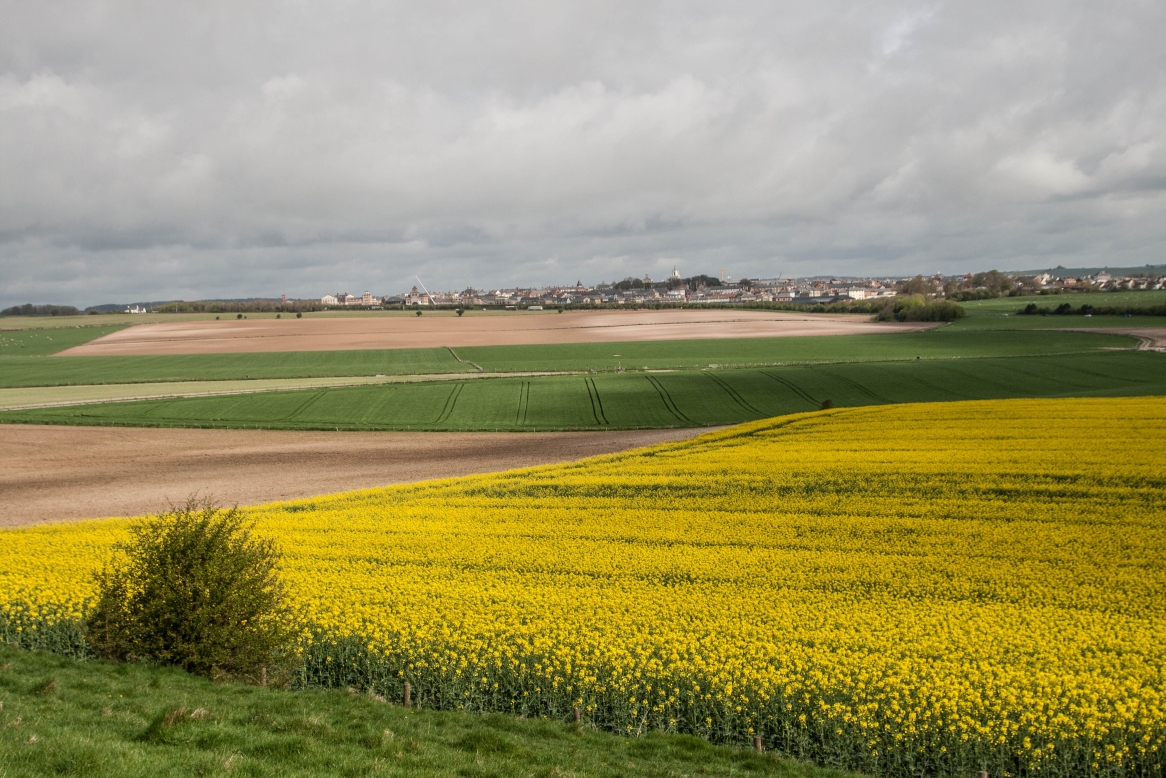
| Frampton from Tibb's Hollow - SY6194 |
Full of expectation, I set off. I had photographed my first gridsquare before in July 2016 on my aforementioned walk, when, looking back at my photos form that walk,
the countryside looked much more lush, but arguably just as wet.
 |
| Near Longlands Farm, July 2016 - SY6194 |
 |
| The same square - my turn off from Tibb's Hollow - SY6194 |
I had even photographed my second square on a walk from Sydling St Nicholas in February 2015.
 |
| Crossing the River Frome at Frampton, Feb 2015 - SY6294 |
I wasn't going anywhere near the river Frome today, however. My walk proper started at Steppes Farm, but first I had to get there through those two squares (Tibb's Hollow being the best parking place I could find).
 |
| Gate at Steppes Farm - SY6294 |
It was wonderful to hear birdsong - Blackbird, Dunnock, Wren and my first Chiff Chaff of the year. I always have to do a double take when I hear my first Chiff Chaff to make sure it's not a Great Tit in reverse! There was also lots of promising Wild Garlic around and lots of lichen-covered gates and stiles. My heart was light even if my rucksack was heavy. I always feel winter is nearly over when the Rooks have started building their nests. I'm rather fond of /Rooks - they're so garrulous and uninhibited. What they lack in looks, they make up for in voice and brashness.
 |
| Rooks and their nests near Steppes Farm - SY6294 |
A rusty old roller attracted my attention at Steppes Farm.
 |
| Old roller at Steppes Farm- SY6294 |
"A rock outcrop, a hedge, a fallen tree, anything that
turns us out of our way, is an excellent thing on a walk. Wrong turnings,
doubling back, pauses & digressions, all contribute to the dislocation of a
persistent self-interest." (from Thomas A Clark, 'In Praise of Walking')
I can certainly testify to that. I need that hedge, that fallen tree, that rusty old roller, those Rooks to grab my attention and stop an otherwise sometimes constant stream of self-analysis, which is sadly at times very self-critical.
But now, here I was in my first new gridsquare of the day, always a momentous occasion and what should I photograph? I left the bridleway to Town Hill farm and continued instead to Church Bottom. I let the name roll round my tongue and bit before photographing what was to be a vision in white in a few weeks when the Wild Garlic had flowered.
 |
| Wild Garlic in Church Bottom - SY6293 |
Hazel Catkins were also dancing in the wind, grabbing my attention.
 |
| Hazel catkins, Church Bottom - SY6293 |
And then a Buzzard was being mobbed by those brazen Rooks, but my photograph was not good enough to include here.
I was following a tributary of the Frome which ends in a pond at Compton Valence, but which provided a pleasant accompaniment to the mewing of the Buzzards and the cawing of the territorial Rooks. Then the benevolence so far encountered on my walk came across a rather large obstacle. Mud, I'm used to that; smelly mud, again what's new? I sloshed my way across to the ning of the gate, oops, wrong side, about turn, unlatch the gate and push, but not before I did most of this little routine, I had noticed a huge tree trunk against the gate on the other side. There was no way this gate was going to budge. I clambered over leaving muddy footprints and made a mental note to report it toe the ROW website upon my return (duly done).
 |
| Blocked gate in Church Bottom - SY6293 |
About here the small tributary had all frothed up looking rather like a plate of mashed potato nicely browned under the grill.
 |
| Foam like mashed potato on Frome tributary - SY6293 |
Gridsquare SY6193 is home to Church Bottom and North and South Slips, all within frampton County Parish. There are two bridleways within the square, both running in a SW/NE trajectory, although Church Bottom flattens out to run almost directly east/west. Imagine if I did that for all the gridsquares!
It was very pleasant walking through this Bottom, which expires conveniently at the border of the next gridsquare.
 |
| Church Bottom - SY6193 |
 |
| Church Bottom and North Slip - SY6193 |
At South Slip I deviated by a few footsteps to take photographs of shivelights and shadows.
 |
| Dancing trees in South Slip, Church Bottom - SY6193 |
"Shivelights and shadowtackle ín long lashes lace, lance, and pair."
(from That Nature is a Heraclitean Fire and of the comfort of the Resurrection
by Gerard Manley Hopkins)
I rejected the option to turn southwards now and curtail my walk by a few miles (through a yet unvisited gridsquare). Instead I continued westwards towards Compton Valence through Compton Bottom, where I had in fact walked once before. I crossed the fast flowing tributary, a glorious chalk stream with Lesser Celandine bordering its waters.
 |
| Chalk tributary of the River Frome - SY6193 |
I crossed this tributary and bade it farewell for I would see it no more. A tumulus guarded the entry to SY6093 as I entered Compton Bottom and joined my walk of 2016 from the same car park to Compton Valence.
 |
| Tumulus in Compton/Church Bottom - SY6093 |
 |
| Bridleway to Longlands Farm (and where my path from July 2016 joined my present one) - SY6093 |
I watched the 'wind hover' Kestrel, reminding me once more of Manley Hopkins:
 |
| The Wind Hover - SY6093 |
"High there, how he rung upon the rein of a wimpling wing"
The ground was bare and brown compared with my lush visit of eighteen months previously.
 |
| Compton Bottom - SY6093 |
 |
| Compton Bottom, July 2016 - SY6093 |
But perhaps then this 'antlered' tree would not have had the same attraction. I shall have to return to see it in leaf.
 |
| Photos of an antlered tree, Compton Bottom - SY6093 |
I was constantly having my attention turned outwards to observe, reflect and be inspired and I was loving it. Taking time to observe closely, to see a tiny piece of sheep's wool written like a short line of music composed on a tree's bark.
My attention was then well and truly taken away from myself by an orchestra of sheep of all sizes, mostly tiny in the form of adorable lambs all bleating their protest at my intrusion which had obviously caused consternation and confusion in their woolly world. Forgive my indulgence in these photos. I was so whisked away into their woolly world and mesmerised by their seeming trust in me - or was it just that they had the wool pulled over their eyes for a moment and mistook me for their mother (can't imagine why). I've never quite had that overwhelming experience with woolly creatures before - in fact I don't think anything or anyone has ever run up to me with the same expectation as those tiny lambs had. It was quite touching.
 |
| Sheep and lambs in Compton Bottom - SY6093 and SY5993 |
 |
| Not too bothered, Compton Bottom - SY5993 |
After a lot of running around most lambs were matched with their mothers.
I left Compton Bottom to a chorus of bleats and baas as I entered the hamlet of Compton Valence.
 |
| Sheep and lambs in Compton Bottom - SY5993 |
I would recover from my sheep interlude at the church where the Daffodils and Primroses were doing their best to bathe the morning in soft and comforting shades of yellow.
 |
| Church of St Thomas a Beckett, Compton Valence - SY5993 |
 |
| Church of St Thomas a Beckett, Compton Valence - SY5993 |
 |
| Church door, Compton Valence - SY5993 |
I gave the door a shove and had a brief look inside.
Apparently this village has a beautiful display of snowdrops in February, but right now I felt like making a return visit in warmer climes,
so continued on the MacMillan Way which led to the destination of the Frome's tributary which I'd been following at Tout Hill.
 |
| Pool at foot of Tout Hill - SY5993 |
I followed the MacMillan Way up Tout Hill, which I think was the sole hill of the walk.
 |
| Ascending Tout Hill - SY5993 |
This emerges at the Roman Road which I'd walked short sections of on previous walks (Maiden Newton to Toller Porcorum, Three Churches and Askerswell to Litton Cheney). I'd never set foot in this gridsquare and there wasn't much to see in it other than the odd pit here and there.
 |
| Pit - SY5892 |
When I reached the road I was disgusted to see a pile of old tyres, boxes and other rubbish just left by the side of the road. This is an utter disgrace.
 |
| Disgrace on the Roman Road- SY5892 |
I had about three-quarters of a mile to walk along this road, which wasn't altogether unpleasant with its views north across field systems to Compton Valence. Annoyingly though I had noticed that my GPS was showing that its batteries were very low. Why hadn't I bought more this morning at the Co-op when I'd thought about it?
 |
| Compton Valence from the Roman Road- SY5892 |
 |
| Compton Valence turn off from the Roman Road - SY5992 |
 |
| Roman Road near Compton Valence - SY5991 |
 |
| Field systems near Compton Valence - SY5991 |
Still I was happy to turn off onto a bridleway leading to Winterbourne Abbas. I was in a field of crops dotted with sheep who, in contrast to the last field of sheep I was in, couldn't have been less interested in me. I stepped over an electric fence to walk diagonally across the field along the path which looked well trodden.
 |
| Path through crops near Lankham Eweleaze - SY6091 |
There wasn't much to hold my interest here and I was glad to reach a track which would lead into the village of Winterbourne Abbas.
 |
| Track to Winterbourne Abbas - SY6191 |
 |
| Track to Winterbourne Abbas - SY6190 |
This is a village we have only scratched the surface of on a few times, to stop hastily to buy horse manure, to reach the outskirts of on our way to Abbotsbury and I think that's it. But somewhere lodged in the archives of my brain was a memory of a petrol station, which, if I was lucky meant shop and that meant batteries! After several miles of walking alone through mud and not meeting a single person, I was suddenly rushed into the 21st century once more with cars dashing past on the busy A35 and pedestrians dodging me on the pavement.
It took a while to cross the road; I was determined I was not going to walk several yards in either direction to reach a proper crossing. I wanted to cross here and now thank you very much. 'Here and now' being opposite the church.
 |
| St Mary's Church, Winterbourne Abbas - SY6190 |
I finally made it across and paused to photograph the chalk stream flowing by the road. The South Winterbourne wends its way through several villages which bear its name: Winterbourne Came, Farringdon (now deserted), Herringston, Monkton, St Martin (Martinstown), Steepleton and Abbas. The stream is itself a tributary of the Frome, Dorset's longest river, and the name 'Winterbourne' means a stream which only flows during the winter months. I'm sure that's not entirely true of this one though!
I had spent several days last year exploring the theme of the South Winterbourne in a creative writing workshop called DIVA which I had found truly inspirational. Since then I had been keen to visit these villages which bear the name of this stream.
 |
| South Winterbourne at Winterbourne Abbas - SY6190 |
I paid the church a quick visit, but decided to carry on to Winterborne Steepleton before stopping for lunch. I was glad to see that yes, there was a garage and it sold batteries. Replenished I continued along the A35 until I reached the road that we normally turn off onto on our way to Abbotsbury. This was not a pleasant part of the walk as the road was very busy and it is difficult to cross. That was now the third time that day I had had to cross it. Only one more time to go!
 |
| South Winterbourne at Winterbourne Abbas - SY6190 |
 |
| Inside St Mary's Church, Winterbourne Abbas, note the balcony, an unusual feature I think - SY6190 |
Almost immediately after turning off onto this road, there is a footpath leading eastwards across North Hill to Winterbourne Steepleton, my next Winterbourne and my next gridsquare (losing count now).
 |
| North Hill near Winterbourne Steepleton - SY6290 |
I immediately made the mistake of not climbing the hill here, ergo not following the footpath, ergo, getting nowhere fast. When it became obvious that I was not going to get through the thicket of bramble and blackthorn I reluctantly backtracked and made my way up the hill until I joined another footpath which descended into the village of Winterbourne Steepleton. I could see it for a while before I entered it.
 |
| Winterbourne Steepleton from North Hill - SY6290 |
 |
| An arresting tree at foot of North Hill - SY6290 |
 |
| An arresting tree at foot of North Hill - SY6290 |
 |
| An arresting tree at foot of North Hill - SY6290 |
 |
| An arresting tree at foot of North Hill - SY6290 |
When I had finally torn myself away from this tree which seemed to be bowing before me, I was then stopped in my tracks my a little wooden chalet which was bulging at the seams with brambles and other vegetation. It was certainly giving nature a home or rather nature was squatting on its premises and it was going to be hard to get rid of it! Who would want to!?
 |
| Nature squatting, Winterbourne Steepleton - SY6289 |
I stepped into the village of Winterbourne Steepleton. Now this village I have no recollection of at all. But there was the South Winterbourne adorned with Daffodils.
 |
| South Winterbourne, Winterbourne Steepleton - SY6289 |
 |
South Winterbourne, Winterbourne Steepleton - SY6289
|
As soon as I saw St Michael's Church, I was glad I'd waited until now to have my lunch. I was going to be eating with the garrulous Rooks. A sign apologised that the church was closed at the moment due to falling plaster. There was no bench and feeling very reverent I chose not to sit on the table graves, but got out my mat and sat on a little hummock at the back of the church and got out my feast. I'd been looking forward to my pork pie for several miles now. I only ever allow myself this gelatinous luxury when I'm walking (same with apples which are only ever so slightly more healthy).
With the Rook's symphony playing in my ears, I sat munching away for several happy minutes, willing the Rooks into position for a good flight photograph.
 |
| St Michael's Church, Winterbourne Steepleton - SY6289 |
 |
| Rookery, Winterbourne Steepleton - SY6289 |
I had a short section of road walking to do before turning off onto the footpath to Martinstown or Winterbourne St Martin as I prefer to call it in keeping with my winterbourne theme.
 |
| Footpath to Martinstown - SY6389 |
 |
| Footpath to Martinstown - SY6389 |
I passed through some village earthworks and caught up once more with my winterbourne.
 |
| Village earthworks, Winterbourne St Martin - SY6389 |
 |
| South Winterbourne - SY6489 |
Then I came to the delightful village of Winterbounre St Martin about which I had read and heard so much during my creative writing workshop. As usual I can't remember much now. One of the first things I came across was the sheep washing pool, used each day in May to wash the flocks of sheep from the village farms and surrounding area prior to shearing, since a higher price could be obtained for clean fleeces.
Sheep washing was carried out in a deep pool – the washpool or wash 'dub' – in a dammed up river or stream, in which the sheep were dropped and forced to swim to get back out. The flock were gathered in a washfold, built on the bank with an opening facing the pool.
The washing pool in Winterborne St Martin has sides of one metre high and a dip 3 metres in diameter. Entry for water from the South Winterborne River is on the north side, the exit on the south side with monolithic jamb stones, each channelled to take a sluice gate. Access to the dip from the south east is via five shallow stone steps. The washing pool was last used in the 1960s. (Information from Geocaching.com)
 |
| Sheep wash pool, Winterbourne St Martin - SY6489 |
 |
| South Winterbourne, Winterbourne St Martin - SY6489 |
I wandered across the Village Green to the church of St Martin. The Green was once the scene of the village fete, held every November around St Martin's Day (11th). The last such fair was held in 1982.
 |
| St Martin's Church, Winterbourne St Martin - SY6489 |
 |
| Cross-stitch collage, St Martin's Church, Winterbourne St Martin - SY6489 |
 |
| Bible, St Martin's Church, Winterbourne St Martin - SY6489 |
Nature had reclaimed its home within the telephone box in the village.
 |
| Phone box, Winterbourne St Martin - SY6489 |
I retraced my steps to the Brewers Arms, the Wash Pool and the bridleway north. I was on the homeward stretch now with few gridsquares left.
 |
| The Brewer's Arms, Winterbourne St Martin - SY6489 |
I followed the bridleway north, not looking forward to the short stretch of A road walking that was ahead of me.
 |
| Leaving Winterbourne St Martin - SY6489 |
Thankfully it was only a very short stretch and then I was back on another bridleway signposted to Bradford Down Farm. That wasn't my destination, however. I passed a chalk pit and another pile of wooden rubbish - lots of pallets.
 |
| Bridleway and track to Bradford Down Farm - SY6490 |
 |
| Another eyesore - chalk pit near Bradford Down Farm - SY6490 |
Once through the woods I saw some Roe Deer, the first of the day and watched them bound gracefully across the fields as I plodded on. Despite the miles I still felt invigorated. There hadn't been much uphill to tackle and I'd been content taking lots of photographs and not worrying about holding anybody up.
The bridleway turns off before reaching Bradford Down Farm and then I was in the field with the biggest horse in the world. It idled over to me, definitely a male and towered over me. I remembered Paula's advice and held out my arms to make myself look big, much bigger than I felt. I was very aware of my dwarfed size and this beast's immense power should it wish to use it against me.
 |
| Giant horse near Higher Skippet Farm - SY6490 |
There was nothing much other than field to photograph in the next gridsquare.
 |
| Bridleway near High Skippet Farm - SY6491 |
And then I was at Higher Skippet Farm where I saw my first fellow walker and dog. We bade each other a curt good afternoon and I waited until I'd reached somewhere more picturesque for my photograph. I'd toyed with the idea of detouring to visit the trigpoint at Knowle Hill, but was running out of energy and time. The sign for Hampton Lodge made an attractive subject for my photo.
 |
| Hampton Lodge sign - SY6391 |
Then it was a pleasant walk through woodland which I would like to return to when the trees are in leaf.
 |
| Hampton Plantation - SY6392 |
A corrugate iron building in the woods looked inviting and I mused on its history.
 |
| Habitation in Hampton Plantation - SY6392 |
The forest floor was a carpet of spring flowers.
 |
| Spring flowers in Hampton Plantation - SY6392 |
I followed the metalled track through the plantation which looked like it was once a deer park; I had passed the Keeper's Cottage.
 |
| Hampton Plantation - SY6392 |
 |
| Hampton Plantation - SY6292 |
I had photographed my final gridsquare for the day, but there was still plenty to see, the delightfully named Pigeon House and a Green Woodpecker yaffling away and then moving from one telegraph pole to the other, always just out of range for a photograph (with this camera anyway).
 |
| Pigeon House, Hampton Plantation - SY6293 |
 |
| Bulbous tree in Hampton Plantation - SY6293 |
Soon I was at the end of the bridleway and back where I had started at Steppes Farm.
 |
| Bridleway to Steppes Farm from the south - SY6293 |
 |
| Frampton from Tibb's Hollow - SY6194 |
That had been a very self-indulgent and delightful walk and one I hope to repeat with paul in a few weeks' time to see how the scenery has changed.
Number of new gridsquares: 16
Number of miles walked: 12.8
Number of churches visited: 4
Number of blocked gates: 1
Number of Winterbournes walked through: 3
Number of sheep and lambs encountered: 323